
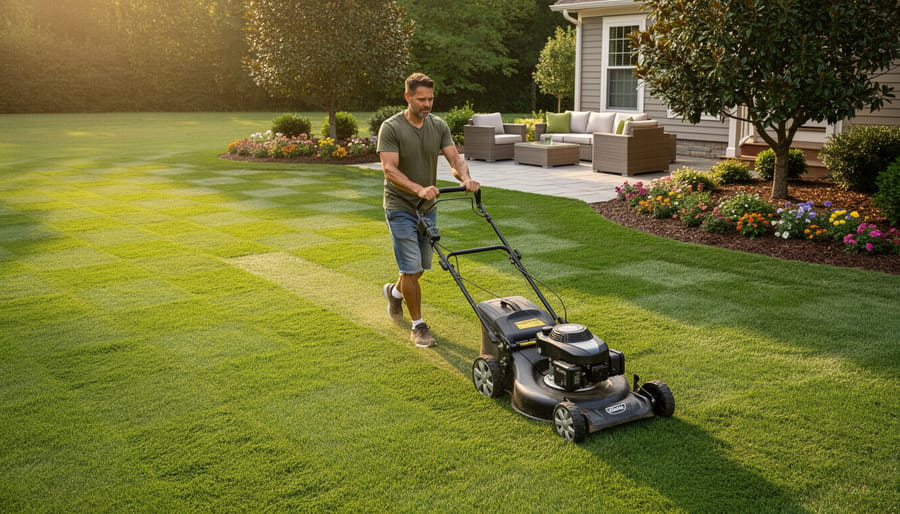
Mow in alternating directions each week to prevent grass blades from leaning permanently in one direction, which creates unsightly striping and weakens root development. This simple shift—north-south one week, east-west the next—trains your lawn to grow upright and dense, resulting in that golf course appearance you’ve been chasing.
Set your mower blade height to remove only the top third of grass blades in a single session, keeping most varieties between 2.5 to 3.5 inches tall. Cutting shorter might seem efficient, but it scalps the lawn, exposing soil to weeds and stressing plants during hot weather. Taller grass develops deeper roots, shades out competing weeds naturally, and maintains that rich green color through summer stress.
Sharpen your mower blades every 20-25 hours of use to ensure clean cuts rather than ragged tears that turn grass tips brown and invite disease. A sharp blade slices through each stem cleanly, allowing the plant to heal quickly and maintain its vibrant appearance. You’ll notice the difference immediately—freshly cut lawns with sharp blades look professionally manicured rather than bruised.
Create decorative patterns by overlapping your mowing passes slightly and using a roller attachment or simply the weight of your mower to bend grass in specific directions. Light and shadow play across these bent blades differently, revealing checkerboards, diamonds, or waves that transform your yard into an outdoor canvas. This artistic dimension elevates routine maintenance into creative expression, turning every mowing session into an opportunity to reimagine your landscape as a living work of art that changes with each season.
Why Traditional Mowing Falls Short
We’ve all been there—pushing the mower in the same predictable lines, week after week, treating our lawns like carpets that simply need trimming. While this approach certainly keeps grass at a manageable height, it’s missing the bigger picture of what your outdoor space could become. Traditional back-and-forth mowing might seem efficient, but it’s actually holding your lawn back from reaching its full potential, both aesthetically and in terms of overall health.
The repetitive nature of conventional mowing creates several challenges that most homeowners don’t even realize they’re facing:
- Uneven wear patterns develop as wheels and feet compress the same pathways repeatedly
- Soil compaction builds up in heavily trafficked zones, restricting root growth and water absorption
- Visual monotony leaves your lawn looking flat and uninspired, lacking character or dimension
- Inconsistent grass health emerges as some areas receive ideal cutting while others are scalped or left too tall
Beyond these practical concerns, traditional mowing represents a missed opportunity for creative expression. Your lawn is essentially a living canvas, yet most of us treat it like a chore rather than a chance to craft something beautiful. Think about it—you wouldn’t paint a masterpiece using the same brushstroke over and over, would you?
This is where innovative mowing techniques come into play. By understanding lawn care basics and building upon them with varied mowing patterns, directional changes, and intentional design choices, you transform routine maintenance into an art form. These fresh approaches don’t just make your lawn look better—they actually improve grass resilience, encourage more even growth, and prevent the soil compaction issues that plague conventionally mowed yards.
The shift from traditional to innovative mowing isn’t complicated, but it does require rethinking what mowing can accomplish. Instead of simply cutting grass, you’re now sculpting, creating patterns, and nurturing a healthier ecosystem right outside your door.
Pattern Mowing: Creating Lawn Artistry
Striping Techniques for Professional Results
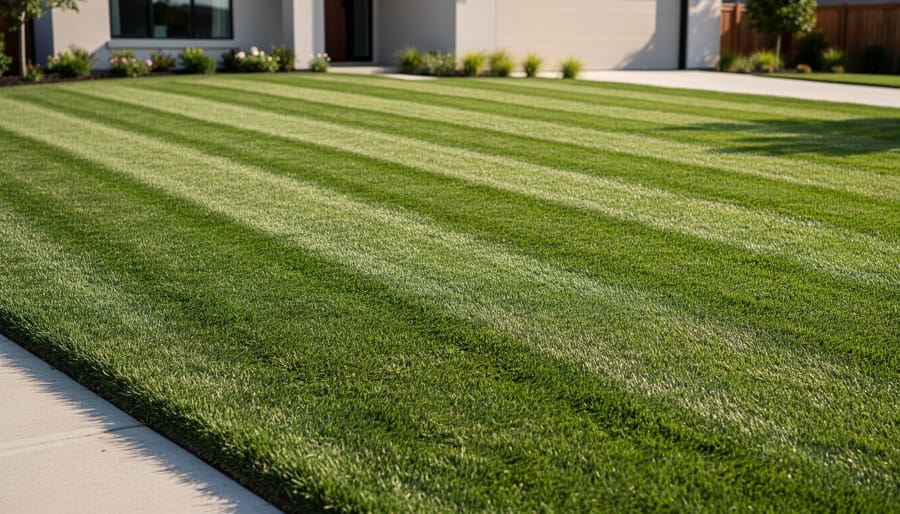
Ever wonder how professional groundskeepers achieve those gorgeous, eye-catching stripes on baseball fields and golf courses? The secret isn’t magic—it’s all about understanding how light plays with your lawn. When you mow in alternating directions, the grass blades bend different ways, creating contrasting dark and light bands. The darker stripes reflect light away from you because the blades are bent away, while lighter stripes reflect more light back because the blades are bent toward you. It’s a beautiful dance between grass blade characteristics and simple physics.
The good news? You can create this professional look in your own yard with consistent technique and a little patience. Here’s your roadmap to striping success:
- Start with freshly mowed grass at your desired height—stripes show best on healthy, well-maintained lawns.
- Choose your stripe direction, keeping in mind that stripes running toward viewing points (like your house or patio) create the most dramatic visual impact.
- Mow your first pass in a straight line, using a focal point in the distance to maintain alignment.
- At the end of each row, lift your mower deck slightly as you turn to avoid creating pivot marks.
- Mow the return pass in the opposite direction, directly alongside your first stripe.
- Continue alternating directions with each pass, maintaining consistent overlap to avoid missed strips.
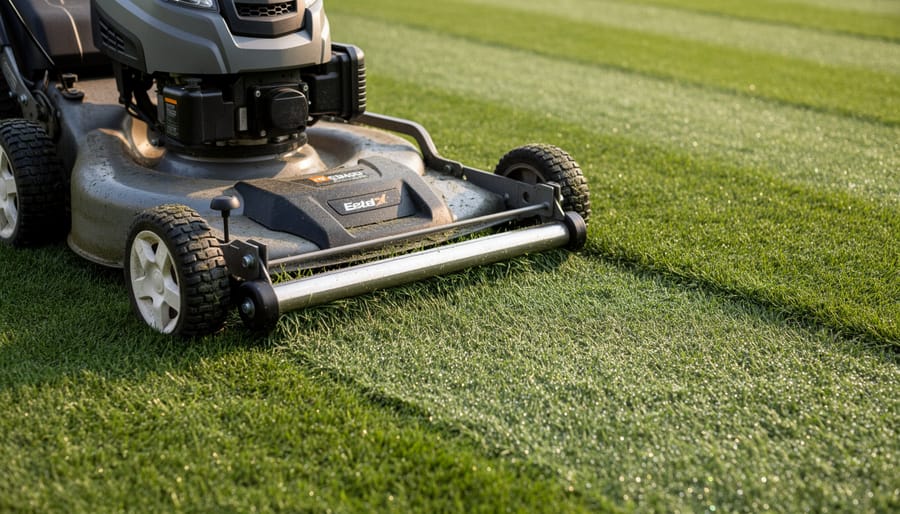
For even more pronounced stripes, consider adding a striping kit to your mower. These weighted rollers attach behind your mower deck and emphasize the grass bend, making patterns pop with minimal extra effort. Many enthusiasts in our community have reported that combining striping kits with slightly taller grass heights produces the most dramatic results. Remember, cooler-season grasses like fescue and bluegrass typically show striping better than warm-season varieties due to their blade flexibility and growth patterns.
Checkerboard and Diamond Patterns
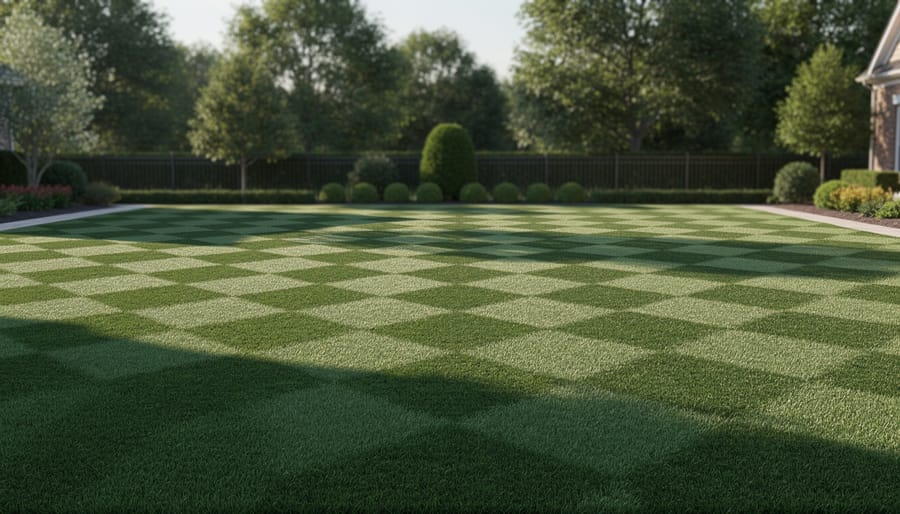
Ready to transform your lawn into a true work of art? Checkerboard and diamond patterns add sophisticated visual interest that’ll have your neighbors doing double-takes. These geometric designs might look complex, but with a bit of planning, you can master them in just a few sessions.
Start with the checkerboard pattern, which is more forgiving for beginners. The secret lies in mowing alternating squares in perpendicular directions. Begin by mowing your entire lawn in one direction as usual. On your next mowing session, select every other strip and mow perpendicular to your original pass. The grass blades will bend in different directions, catching light differently and creating that classic checkerboard effect. For best results, use a mower with a roller attachment to enhance the bend.
Diamond patterns require a similar approach but with diagonal passes. Map out your lawn mentally or sketch it on paper first. You’ll mow in diagonal stripes one week, then switch to the opposite diagonal the following week. The intersecting angles create stunning diamond shapes that appear almost three-dimensional.
Pattern visibility depends heavily on grass height and health. Maintain your lawn between 2.5 to 3.5 inches for optimal pattern definition. Taller grass bends more dramatically, making patterns pop. Keep your mower blades sharp to ensure clean cuts that reflect light beautifully.
Don’t get discouraged if your first attempt looks uneven. Like any artistic skill, pattern mowing improves with practice. Share your progress with fellow garden enthusiasts online and gather inspiration from their creative designs.
Circular and Wave Designs
Ready to transform your lawn into a flowing work of art? Circular and wave designs take your mowing from functional to phenomenal, creating eye-catching patterns that’ll have neighbors stopping to admire your handiwork.
These graceful patterns work beautifully on medium to large lawns where you have space to let curves develop naturally. Start by visualizing your design—think rippling water, spiral galaxies, or gentle ocean waves. The key is working with your mower’s turning radius rather than fighting against it.
For best results, use a mower with a tight turning radius or a zero-turn model that gives you maximum control. Begin at a central point for spirals, mowing outward in expanding circles. For wave patterns, establish a flowing baseline along one edge, then create parallel waves that mirror that initial curve.
Here’s a practical tip: use landscape flags or biodegradable spray paint to mark your intended pattern before mowing. This guide helps maintain consistent curves, especially when you’re still developing your technique.
The striping effect comes from mowing in alternating directions, so each curve should flow opposite to the previous one. Overlap your passes slightly to avoid gaps, and maintain a steady speed for uniform results. With practice, you’ll develop an intuitive feel for creating these artistic designs that turn ordinary lawn care into creative expression.
The One-Third Rule and Variable Height Mowing
One of the most transformative concepts in lawn care is the one-third rule, which states you should never remove more than one-third of the grass blade in a single mowing session. This simple guideline protects your lawn from stress, helps maintain deeper root systems, and keeps your grass vibrant and resilient. But here’s where innovation meets tradition: you can apply this rule creatively across different zones of your lawn to craft purposeful, visually interesting outdoor spaces.
Think of your lawn as having different functional areas, each with its own personality. Your front yard might serve as a welcoming carpet, while a backyard play area needs durability, and perhaps a meditation corner deserves a meadow-like feel. By adjusting your mowing heights strategically across these zones while respecting the one-third principle, you create depth, texture, and visual intrigue.
For high-traffic areas like pathways or play spaces, maintain a shorter cutting height of around 2 to 2.5 inches. This creates a manicured, accessible surface that stands up to foot traffic while staying tidy. In contrast, border areas or sections beneath trees can be left slightly taller, at 3 to 4 inches, creating a softer, more naturalistic transition that also helps shade out weeds and retain soil moisture.
The key is transitioning gradually between these heights. Rather than creating jarring lines, allow your mowing pattern to shift progressively from one zone to another, much like an artist blending colors on a canvas. This graduated approach not only looks more intentional but also prevents the stress that comes from dramatic height changes.
Remember to adjust your expectations with the seasons too. During hot summer months, raising your blade height by half an inch across all zones helps grass retain moisture and resist heat stress. In cooler seasons, you might lower it slightly for a cleaner appearance.
This variable height approach transforms mowing from a monotonous chore into a design opportunity. You’re not just cutting grass; you’re sculpting living spaces that serve different purposes while maintaining the health and vitality of every blade. Share your multi-height lawn designs with fellow garden enthusiasts and inspire others to see their outdoor spaces as dynamic, purposeful canvases.
Directional Mowing Rotation for Healthier Grass
Think of your lawn as a living canvas that responds to every touch. Just as artists vary their brush strokes to create texture and depth, changing your mowing direction each time you cut creates a healthier, more resilient lawn. This simple yet transformative technique does more for your grass than you might imagine.
When you mow in the same direction week after week, your mower wheels create ruts in the soil, and grass blades begin to lean permanently in that direction. By alternating your mowing pattern, you encourage each blade to grow straight and strong, like training a plant to reach for the sun from all angles. This practice also plays a vital role in preventing soil compaction, allowing air, water, and nutrients to penetrate deeper into the root zone where they’re needed most.
The biological benefits are remarkable. Grass that stands upright captures more sunlight for photosynthesis, producing stronger roots and thicker turf. You’ll notice fewer bare spots and better resistance to foot traffic. The varied pressure patterns also distribute wear evenly across your lawn, preventing those unsightly pathways and trampled areas that develop over time.
Here’s a simple rotation schedule to follow:
| Week | Mowing Direction | Benefits |
|---|---|---|
| Week 1 | North-South | Establishes baseline pattern |
| Week 2 | East-West | Counters initial lean, opens new pathways |
| Week 3 | Diagonal NE-SW | Reaches overlooked areas, adds variety |
| Week 4 | Diagonal NW-SE | Completes full rotation cycle |
This four-week cycle ensures comprehensive coverage while keeping your routine fresh and engaging. As you walk your lawn from different angles, you’ll also discover new perspectives on your garden’s layout and design opportunities you might have missed. It’s a small change that creates big rewards, turning routine maintenance into an opportunity for creative observation and lawn improvement.
Mulching vs. Bagging: The Smart Choice
Here’s a question that transforms your weekly lawn care routine into an eco-friendly choice: should you collect those grass clippings or let them work their magic on your lawn? The answer might surprise you and reshape how you think about mowing.
Mulching has emerged as a garden artist’s secret weapon. Instead of bagging clippings, a mulching mower finely chops grass and returns it to your lawn, where decomposing clippings provide valuable nutrients back to the soil. Think of it as nature’s recycling system working right beneath your feet. Those tiny clippings break down quickly, feeding your lawn with nitrogen and reducing your fertilizer needs by up to 25 percent—a win for both your wallet and the environment.
The beauty of mulching extends beyond nutrition. You’ll spend less time hauling bags to the curb, reduce landfill waste, and maintain consistent soil moisture as the clippings act like a protective blanket. This approach aligns perfectly with holistic nutrient management strategies that view your lawn as a living ecosystem.
However, bagging has its moments to shine. When grass grows excessively tall after vacation, collecting those lengthy clippings prevents smothering your lawn. During disease outbreaks or when seed heads threaten to spread weeds, bagging becomes your protective measure. Autumn’s fallen leaves mixed with grass also benefit from collection to prevent matting.
The creative approach? Combine both methods seasonally. Mulch during regular maintenance for ongoing nourishment, but switch to bagging when conditions demand it. Your lawn becomes a dynamic canvas where you adjust techniques based on what nature presents, creating healthier, more vibrant results through mindful choices.
Edge Defining and Precision Techniques
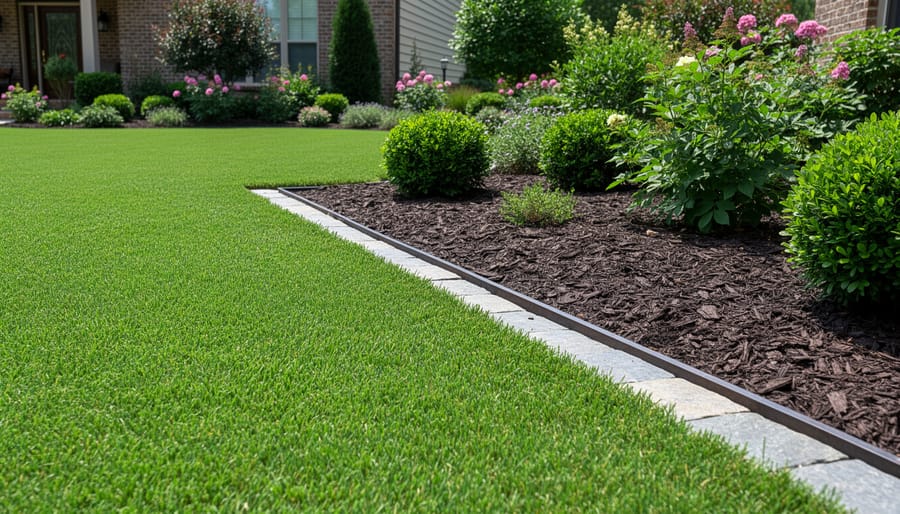
Sharp, defined edges transform an ordinary lawn into a polished masterpiece. Think of edging as the frame around your living canvas—it’s where precision meets artistry, creating boundaries that make your entire outdoor space feel intentional and well-loved.
The secret to professional-looking edges starts with the right approach. A half-moon edger or power edger works beautifully for creating those initial crisp lines along walkways, driveways, and flower beds. Position your tool at a slight angle and work in smooth, continuous motions rather than choppy cuts. This creates a clean channel that naturally prevents grass from creeping into unwanted areas.
For maintaining these edges between major cuts, string trimmers become your best friend. Hold the trimmer vertically and guide it along established lines, letting the spinning string do the work. This technique keeps borders sharp without the heavy lifting required for full edging sessions.
Here’s a community favorite tip: edge before you mow. This prevents clippings from landing on freshly edged areas and creates a cleaner finished look. The debris gets swept up naturally during your regular mowing pass.
Consider the depth of your edges too. A two to three-inch depth provides enough definition without compromising lawn health or creating tripping hazards. Too shallow, and grass roots quickly reclaim the boundary; too deep, and you risk erosion issues.
Practice your technique along less visible areas first. Like any garden skill, precision edging improves with experience. Soon you’ll develop that confident, steady hand that transforms simple maintenance into outdoor artistry.
Tools and Equipment That Make Innovation Possible
The right tools can transform your lawn from a simple green carpet into a living masterpiece. Let’s explore the equipment innovations that are making creative lawn care more accessible than ever.
Striping kits have become game-changers for home gardeners wanting to create those professional baseball field effects. These attachments, which mount to the rear of your mower, use a roller or flap to bend grass blades in different directions. As light reflects off the bent blades, you get those stunning light and dark stripes. Many kits are universal and attach easily to standard walk-behind or riding mowers, making this professional technique available to everyone.
Modern mowers with adjustable deck heights give you precise control over cutting patterns. Multi-level decks allow you to create dimensional effects, while quick-adjust levers let you transition between heights mid-mow for creating borders and accents. This flexibility is essential when you’re experimenting with checkerboard patterns or curved designs.
Robotic mowers are revolutionizing lawn maintenance by handling routine cutting while you focus on creative projects. These autonomous helpers maintain consistent grass height, which actually provides the perfect canvas for your manual striping and patterning work. Think of them as your maintenance crew, freeing you up for the artistry.
Don’t overlook simple attachments like mulching blades, which promote healthier grass growth, or edging attachments that create crisp boundaries for your patterns. Even lawn marking paint and guide strings can help you plan complex designs before making that first cut.
The beauty of today’s equipment is that innovation doesn’t require a massive investment. Start with one enhancement that excites you, master it, and gradually build your toolkit as your lawn artistry evolves.
Seasonal Adjustments for Year-Round Success
Your lawn’s needs shift dramatically throughout the year, and your mowing approach should dance along with these natural rhythms. Think of seasonal lawn care as choreography where timing and technique work together to create a thriving landscape canvas.
Spring awakens your lawn with explosive growth that can feel overwhelming. During this vibrant season, raise your mower blade gradually as temperatures climb, allowing grass to develop deeper roots while maintaining that fresh, manicured appearance. Mow more frequently in late spring, perhaps twice weekly, but never remove more than one-third of the blade height at once. This gentle approach encourages lateral growth, creating the lush density that becomes your summer foundation.
As summer heat intensifies, your mowing strategy becomes a protective shield. Raise cutting heights by at least half an inch to provide natural shade for soil and roots, reducing moisture loss and heat stress. This longer grass also outcompetes weeds and maintains its color better during drought conditions. Consider mowing during cooler morning or evening hours to minimize stress on both you and your lawn.
Fall presents a golden opportunity to prepare your grass for winter’s rest. Gradually lower your blade height over several mowings as growth slows, but keep grass slightly longer than your summer height. This encourages root development while preventing snow mold and disease. Continue mowing until growth stops completely, even if leaves complicate the process—a mulching approach handles both beautifully.
Winter dormancy requires minimal intervention in most climates. Avoid mowing dormant grass entirely, as foot traffic and equipment can damage vulnerable crowns. Instead, use this quiet season to plan next year’s creative mowing patterns and maintenance schedule.
Your lawn is more than just a patch of green—it’s a canvas waiting for your personal touch. Now that you’ve explored these innovative mowing techniques, from directional striping to health-focused patterns that promote stronger grass growth, it’s time to put your mower to work in new and exciting ways.
Don’t be afraid to experiment! Start with simple alternating stripes if you’re new to pattern mowing, then gradually work your way up to checkerboards, diamonds, or even your own unique designs. Remember, every lawn is different, and what works beautifully in one yard might need adjustment in another. The key is to observe how your grass responds and adapt your approach accordingly.
The beauty of these techniques is that they serve dual purposes—creating visual interest while supporting your lawn’s overall health. Whether you’re varying your mowing direction to prevent soil compaction or trying out different cutting heights for optimal growth, you’re investing in both form and function.
We’d love to see what you create! Your unique patterns and creative approaches could inspire fellow gardening enthusiasts in our community. Share photos of your lawn patterns and join the GardenSculpt forum where members exchange tips, troubleshoot challenges, and celebrate their outdoor artistry together. You’ll find a welcoming community of like-minded gardeners who understand that lawn care can be both practical maintenance and creative expression. Happy mowing, and may your lawn become your masterpiece!